10 best offseason moves, from steals to smart deals
By John Hollinger
Getting something for nothing isn't as easy as it looks.
Just ask the Denver Nuggets, for example. Their offseason acquisition of shooting guard J.R. Smith -- who makes his return to the lineup tonight -- seemed like a simple, no-brainer play. Give Howard Eisley's contract and two second-round picks to the Bulls and -- voila! -- the shooting guard problem is solved.
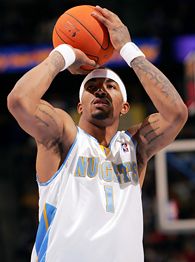 Smith's shooting touch has helped fill a void in Denver.
In reality, Denver's offseason coup was several months in the making, and required a leap of faith or two along the way. The fact that the Nuggets had Eisley and those picks lying around was no accident, but the result of careful planning to take advantage of future opportunities.
Let's start with the signing of veteran guard Eisley at the end of last season. The Nuggets included a nonguaranteed option for a second season in his deal, because they believed somewhere down the road it might allow them to trade with a team looking to shed cap space.
"We had no idea where we were going with it," Nuggets vice president of basketball operations Mark Warkentien said. "Just that it gave us some flexibility in the offseason. Perhaps we'd find a team looking to unload a salary, and Howard would give us the ability to [do something]."
The key to the deal was that Denver owner Stan Kroenke signed off on the additional expense -- the second year on the deal meant the league wouldn't pick up a chunk of his veteran's minimum contract. Many owners wouldn't pull the trigger on that kind of expense with the payoff being uncertain.
"Stan stood way strong," Warkentien said. "He reached into his pocket to give us flexibility, not knowing where we were going with it. Without that, none of the rest can happen." The rest, in this case, was that the Nuggets found the other key to the Smith deal on draft day. Once forward Paul Millsap went off the board, the Nuggets decided to trade their second-round pick "rather than chase some guy who was going to get cut." Denver acquired a second-round choice in 2007, giving it two second-round picks in that draft.
Armed with Eisley's nonguaranteed contract and two second-round picks rather than the one most other teams could offer, the Nuggets were in position to pounce when opportunity struck. When the Bulls acquired Smith over the summer and looked to unload his contract in order to afford newly signed Ben Wallace and clear a backcourt glut, the Nuggets moved in for the kill.
But their work wasn't done. The other concern with trading for Smith was the reputation he developed in New Orleans the previous season. By the end of the season, Smith and coach Byron Scott were no longer on speaking terms, and the shooting guard languished on the bench for most of the second half.
However, the Nuggets were satisfied that they weren't taking too great a risk, for two reasons. The biggest was that coach George Karl was able to tap the Tar Heels mafia to get the lowdown on Denver's potential acquisition.
"George has the Blue tattoo," Warkentien said of Karl's North Carolina connections. "He could find out what he needed to know … at a level that other people couldn't reach."
Additionally, the Nuggets took heart in the fact that character-focused San Antonio had nearly traded for Smith at the trade deadline in 2006.
"I found some comfort in knowing the Spurs had done their homework and came to the same conclusion that I did," Warkentien said.
That conclusion was that they'd found the missing piece needed to space the floor for the league's worst 3-point-shooting team in 2005-06.
"We had strategized the whole summer to allow [Carmelo Anthony] more room to play," Karl said.
It paid off in spades. Smith is shooting 39.7 percent on 3-pointers while draining nearly three a game, and scoring 16.7 points per game overall. Still, Smith has had his moments of immaturity, most notably his role in the scrum at Madison Square Garden that produced a 10-game suspension.
"He's a young player who drives some coaches crazy," said Karl, noting Smith's propensity for fourth-quarter technical fouls. "But there's a passion there, there's a commitment there, and there's a talent there. So I think we're ahead of the curve, we got three [items] on the good side and one on the bad side."
Karl has it right. The good has massively outweighed the bad, and considering the pittance it cost the Nuggets, it makes Smith the year's top offseason acquisition so far. I reviewed the worst moves Tuesday, so today we're going to look at the top 10, led by Smith. The ground rules are the same as yesterday's, so let's cut right to the chase.
1. Nuggets trade Howard Eisley and two second-round draft picks for J.R. Smith
One more reason to like this move: Smith is on his rookie contract this year and next. So not only has Smith radically improved the shooting guard situation, he's doing it while making less than departed predecessor Greg Buckner made out in free agency … an important consideration because the Nuggets are in luxury-tax territory.
2. Magic re-sign Trevor Ariza
I remain completely baffled that nobody made a stronger play for Ariza this offseason. Did somebody find a crop of athletic 21-year-old forwards growing on trees and forget to tell me? Somehow, the 6-foot-8 jumping bean got only a two-year, $6 million deal; his next contract will be worth five or 10 times as much.
Ariza had a disappointing 2005-06 in which he was stuck at the end of the Knicks' bench and insulted by coach Larry Brown, but he was much more productive after Orlando liberated him in the Steve Francis trade. This year he's been even better. Ariza is shooting 54 percent from the floor for the division-leading Magic in addition to his usual solid work on the boards, and establishing himself as a defensive presence as well. His playing time has steadily increased as a result, and now he's breathing down Hedo Turkoglu's neck for the starting small forward gig.
3. Rockets trade Stromile Swift and the rights to Rudy Gay for Shane Battier
I think Rudy Gay might be a heck of a player down the road, and in an up-tempo system Swift can wreak havoc. But on a team such as Houston that plays a rugged, halfcourt style and is focused on winning today because Tracy McGrady's back might not make it till tomorrow, neither player was going to help the cause much.
Battier, on the other hand, has made a huge impact. His spot-up shooting has been helpful (40.4 percent on 3-pointers) but the reason this deal ranks so high is his effect on Houston's defense. The Rockets lead the NBA in defensive efficiency by a wide margin after ranking seventh a year ago, thanks mainly to the acquisition of one of the league's best team defenders. With superior defense, they've been able to shrug off absences by McGrady and Yao Ming to maintain contact with the West's elite. One other sign of Battier's impact: Houston gives up more points than it scores when he's off the floor, which isn't true of any other Rocket.
4. Portland's draft
The Blazers' flirtation with respectability has been mainly the result of a career year from Zach Randolph, but in the long term this season may be memorable for a different reason: The Blazers' great draft crop.
While the Joel Freeland era doesn't seem imminent, Portland's other three first-rounders look like studs. Brandon Roy is the likely Rookie of the Year, and while that's not saying much in this disappointing class, he is scoring 14 a game and will be even more deadly once he figures out the NBA 3-point line. Joining him in the Blazers' backcourt of the future is Spanish import Sergio Rodriguez, who has played well in limited minutes and has posted an insanely high assist rate (11.7 per 40 minutes).
But the best prospect of all may be big man LaMarcus Aldridge, who has played sparingly while the team showcases Jamaal Magloire for a trade. Aldridge can run the floor and shoot jumpers out to 20 feet, and with his length he can get the shot off against anybody. His per-game numbers don't do justice to his performance because he's seen so few minutes, but he's shooting a solid percentage (49.7 percent), dropping in 14.8 points per 40 minutes, and rarely turns the ball over.
5. Bucks trade Joe Smith for Ruben Patterson
Can you even imagine where Milwaukee would be right now if it hadn't made this deal? The Bucks originally pulled the trigger because they felt they needed a backup small forward more than a backup power forward, and they were proven correct when Bobby Simmons' heel problem kept him on the shelf. But Patterson has played better than they could have possibly imagined.
The veteran nomad is having a career year -- no mean feat for a 31-year-old player who is almost entirely dependent on his athleticism. He's shooting 56.4 percent from the floor, pumping in 18.1 points per game, and looking forward to six weeks as the Bucks' go-to guy while Michael Redd's knee heals. Patterson's line from the first game sans Redd indicates he may be up to the task -- 29 points, 12 rebounds, seven assists and four steals against Denver on Monday. (Incidentally, this deal didn't work out so badly on Denver's end either -- Smith was a key piece in the Allen Iverson deal).
6. Mavs extend Josh Howard
Dallas' decision to give Howard a four-year, $40 million extension looked solid at the time. Now it looks positively brilliant. Howard has elevated his game yet again and looks set to make his first-ever All-Star appearance this February, helping Dallas to the league's best record. He's added the 3-pointer to his arsenal to boost his scoring average to 19.4 per game, and upped most of his secondary stats as well.
As a result, he'd be a max-contract player if he were hitting the free-agent market this summer, which would put his deal in the neighborhood of $100 million if he signed for the maximum six years. That's more than double what the Mavs paid. And considering the Mavs are already $10 million over the dollar-for-dollar luxury tax line, this extension will end up saving Mark Cuban tens of millions of ducats over the next few years.
7. Pistons sign Nazr Mohammed
Losing Ben Wallace was a huge blow to the Pistons, but as far as plug-the-hole-in-the-dike moves go, grabbing Mohammed has turned out pretty nicely for Detroit. Mohammed's player efficiency rating is actually substantially better than Wallace's (19.38 to 14.88) thanks to his 57.5 percent shooting mark and his usual yeoman work on the glass. And while Mohammed's defensive impact is nowhere near the same -- Detroit has dropped from fifth to 11th in defensive efficiency -- he's kept the Pistons' frontcourt credible, and could be doing more were it not for Flip Saunders' puzzling tendency to give him the quick hook.
Bonus points go to Detroit team president Joe Dumars on this one because of the alternatives -- in the hands of another exec, the Pistons could easily be lamenting the acquisition of Joel Przybilla, Melvin Ely or Jarron Collins, all three of whom have struggled mightily after re-signing with their teams over the summer. Essentially, Dumars was taking a quiz with only one correct answer, and he aced it.
8. Heat re-sign Alonzo Mourning
As disastrous as the Heat's season has been, it's hard to envision how much worse it would be had Mourning decided to walk off into the sunset after winning a championship last season. Instead, he decided to re-up for two years and $5 million, a pittance for a player with his shot-blocking skill and interior scoring ability.
With Shaquille O'Neal out of the lineup, those skills have been more in need than ever. Zo has sent back 2.8 offerings a game to help make up for his teammates' shameful perimeter defense, and his 57.9 percent shooting from the floor has lent Dwyane Wade one of his few sources of offensive support. He'll retreat into the background once Shaq comes back, but if the Heat manage to eke out a playoff spot, they'll have Mourning to thank for it.
9. Nets trade 2009 second-round draft pick to Seattle for Mikki Moore
Could the Nets possibly have obtained this guy for any less? A second-rounder in 2009? What, they couldn't offer an Amazon.com gift certificate?
Moore may have come cheaply, and he may be paid cheaply (just a hair over a million for this season), but he's the one guy keeping the Nets' heads above water in the Titanic Division right now. With the loss of Nenad Krstic and the demise of Jason Collins, only the play of Moore has averted a full-scale frontcourt disaster. The slender 7-footer is shooting 65.5 percent from the floor and averaging 9.7 rebounds per 40 minutes, but even more important is the energy he's played with -- something that's been glaringly lacking from Jersey's arsenal any time he's off the floor.
10. The Derek Fisher trade
Often when a trade is made, commentators will cop out and say, "I think this deal will help both teams." Usually they're full of it, but every so often a deal plays out that really does have strong benefits for both sides.
The trade between the Warriors and Jazz this summer was one example. Utah desperately needed guard help and outside shooting, and got both of them at a stroke when it sent two nonguaranteed contracts and backup point guard Keith McLeod to the Warriors for Fisher. Fisher's shooting and defense have solidified the backcourt enough that the Jazz are comfortably ensconced in first place in the Northwest Division.
That deal also had benefits for Golden State, allowing it to unload one of the worst mistakes of the Chris Mullin era: the six-year, $36.6 million contract he gave Fisher in 2004 (sadly, this was soon to be outdone by larger deals for Adonal Foyle and Mike Dunleavy). The deal not only allowed the Warriors to skirt the luxury tax, it also let phenom Monta Ellis move into Fisher's vacated backcourt spot and establish himself as a rising star, averaging 17.4 points per game. Meanwhile, Fisher's contract wasn't poisonous for the Jazz because they've managed their cap space so well. So in the end, everybody won, and both the Warriors and Jazz are better this year as a result.
Honorable mention: Some other wise moves this offseason warrant mentioning. For instance, San Antonio rebuilt its center position on the fly and saved several million doing it, replacing Mohammed and Rasho Nesterovic with Francisco Elson and Jackie Butler and appearing none the worse for it. …
Phoenix's five-year, $33 million extension for Leandro Barbosa now looks like a screaming bargain. …
Brian Cook's three-year, $9 million extension with the Lakers is another example of money well spent. …
Houston's theft of Kirk Snyder should start to pay dividends now that he's almost back from a wrist injury. …
Since I've been killing the Hornets, one wise thing they did was signing Jannero Pargo for the minimum so they'd have some insurance in case oft-injured Bobby Jackson got hurt. Jackson's on the shelf again, so Pargo can keep gunning away. …
Toronto rebuilt its frontcourt by signing Jorge Garbajosa and trading for Nesterovic. Not sexy stuff, but the interior D is worlds better. …
I have to restrain myself from giving the Warriors major props for signing Matt Barnes because he basically fell into their lap on the first day before training camp, but he's giving them big-time production for the league minimum. …
Same goes for Portland and Ime Udoka, who was only in camp because he's from PDX. …
Not that it matters, but the Grizzlies are getting way more than they bargained for from Chucky Atkins. …
Indiana's trade of Anthony Johnson for Darrell Armstrong and two nonguaranteed contracts is working out better than the Pacers could possibly have expected. …
Shavlik Randolph was an under-the-radar free agent who signed cheap and continued to play effectively before going down with a bad ankle injury. …
Fellow Sixer Alan Henderson is enjoying a bit of a late-career renaissance as a not-too-shabby backup center. …
Jacque Vaughn has outplayed Beno Udrih and given the Spurs another option behind Tony Parker. …
And finally, kudos to Utah for stealing forward Millsap in the middle of the second round of the draft.


